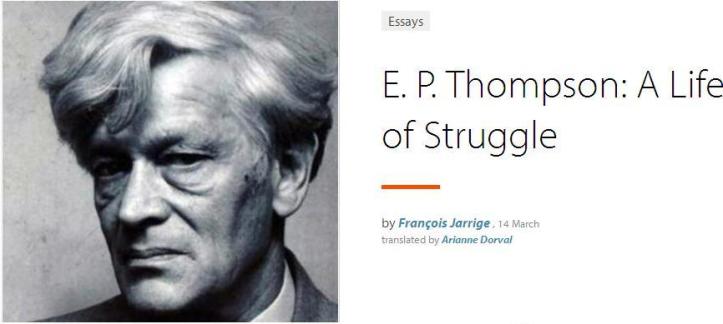
A great historian of the English working class, a major intellectual figure in debates surrounding Marxism in the years 1960-1970, and an anti-nuclear activist who initiated an environmentalist critique of capitalism—such were the many faces of Edward Palmer Thompson, whose work deeply permeates the different social sciences to this day.
Long little known in France, the work of English historian E. P. Thompson has now gained significant recognition, as reflected in recent translations and publications. [1] A major figure of British historiography and an insatiable activist, Thompson developed an original body of work while simultaneously waging virulent political battles. His influence rapidly reached beyond the mere world of historians: By renewing the study of social classes and the law, by placing actors and their experience at the heart of his thinking, and by exploring the roots of capitalism and popular resistance in original ways, he left his mark on the social sciences of the second half of the twentieth century. Though he was the object of intense criticism during his lifetime, he has been repeatedly canonized since his death in 1993. A look back at the trajectory and commitments of one of the great intellectual figures of the twentieth century is therefore essential.
The “Decade of Heroes”
Thompson was born into a cosmopolitan family (his father taught Bengali after having lived in India), in Oxford, in 1924. The period that ran from the Popular Front to the Liberation played a decisive role in his intellectual and political formation. He later called it the “decade of Heroes”—a period of troubles and difficulties, but also one of courage and hope. [2] In 1942, while still a student at Cambridge, he joined the small British Communist Party. He then served in the Army, participating in military campaigns in North Africa and Italy. His older brother, who had become a Communist in the wake of the atrocities of the Spanish Civil War and the persecutions of Hitler, died in 1944 while serving as liaison between the British Army and Bulgarian communists and antifascist partisans. Thompson was deeply affected by this death. [3]
 babilown.com